
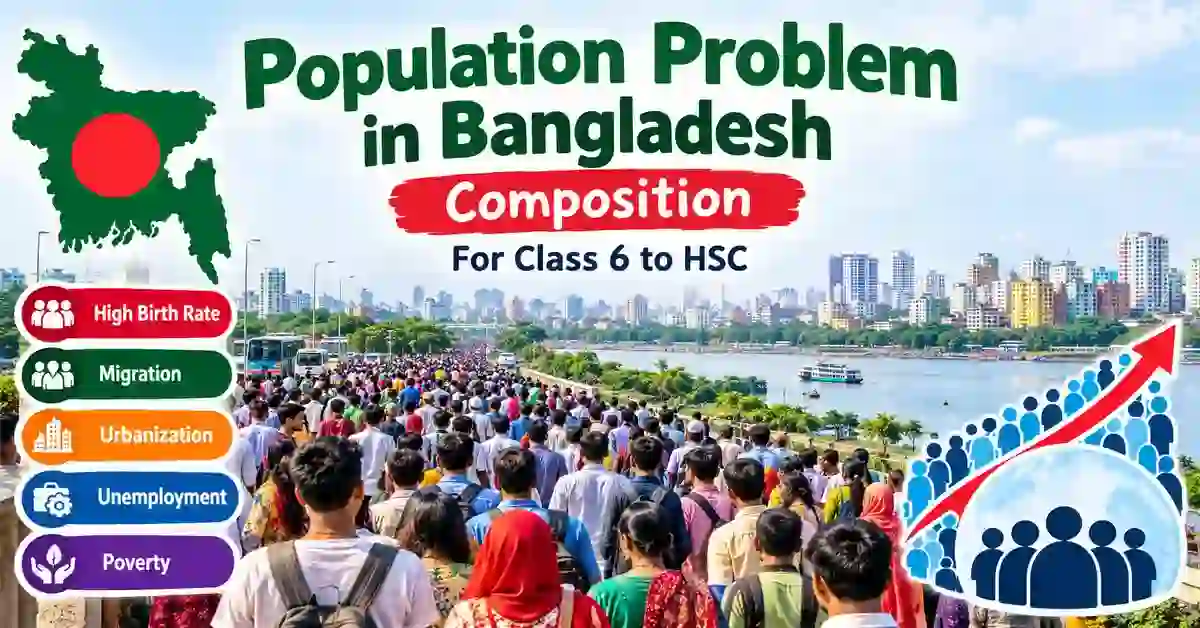
Population Problem in Bangladesh Composition tailored for students from Class 6 up to HSC.Bangladesh is a small country with a massive population. While population is an asset under proper conditions, overpopulation has become one of the most critical challenges for our nation. Below are detailed and structured compositions on “Population Problem in Bangladesh” tailored for students from Class 6 up to HSC.
Read More: Importance of reading newspaper composition for Class 6, 7, 8, 9, 10, SSC and HSC
Population Problem in Bangladesh Composition for Class 6-8
Geographically compact with an area of 147,570 square kilometers, Bangladesh supports a staggering population of over 160 million. A density of roughly 1000 people per square kilometer alongside an annual population surge of over two million individuals underscores an impending demographic crisis.
While population serves as a developmental asset under optimal conditions, it deteriorates into a national crisis when a state cannot guarantee basic provisions food, clothing, shelter, education, and medical care. In Bangladesh, resource constraints make universal provision of these necessities unfeasible.
The rapid escalation of population is rooted in systemic social issues. Mass illiteracy paired with religious superstitions acts as the primary driver. Social customs such as early marriage, polygamy, rigid dogmatism, and an absence of civic awareness accelerate the population expansion rate.
The ramifications of overpopulation permeate every stratum of society. Extreme congestion plagues transport systems and educational institutions, while housing shortages force impoverished citizens to sleep in railway stations or under open skies. Unemployment multiplies, generating societal frustration, lawlessness, and administrative instability. Agricultural yield fails to match consumption demands, creating food deficits and forcing the government to divert capital from development initiatives toward basic survival provisions, straining the national economy.
Curing this national malady requires firm government resolve combined with public cooperation to control birth rates and boost food production. Eradicating illiteracy, banning early marriage, and spreading mass awareness are mandatory steps. Without immediate, unified action, national progress will stall, leaving Bangladesh lagging behind globally.
Read More: Wonder of Modern Science Composition for Class 6, 7, and 8 (Easy & High-Scoring)
Population Problem in Bangladesh Composition for Class 10
Bangladesh is a small territory of 147,570 square kilometers carrying an immense demographic load of more than 160 million citizens. With a population density scaling up to 1000 individuals per square kilometer and a yearly increment exceeding two million people, the country faces an alarming population explosion.
Human capital represents a nation’s strength, but it becomes a liability when infrastructural capacity fails to sustain basic necessities like food, clothing, shelter, healthcare, and education. In Bangladesh, these essential provisions remain out of reach for a vast segment of the populace due to overpopulation.
The exponential rise in population stems from specific socio-economic vulnerabilities. Educational backwardness (illiteracy) and superstitious beliefs form the nucleus of the problem. Institutionalized practices like early marriage, polygamy, dogmatic traditions, and poor social consciousness compound the crisis.
Overpopulation exerts immense pressure on infrastructure and social order. Severe overcrowding is visible across public transport and educational sectors, while a lack of shelter leaves homeless individuals sleeping outdoors. Escalating unemployment fuels public frustration and erodes law and order. Agricultural stagnation relative to population growth causes food scarcity, paralyzing national development plans and placing heavy burdens on the economy.
This demographic crisis is a profound malady for Bangladesh. Resolving it requires coordinated state and public determination to limit family sizes, eliminate illiteracy, abolish early marriage, and foster national awareness before the crisis becomes irreversible.
Read More: Aim in Life Composition for Class 6, 7, 8, 9, 10, SSC and HSC
Population Problem in Bangladesh Composition for SSC
Bangladesh, constrained within a landmass of 147,570 square kilometers, sustains an enormous population exceeding 160 million. A population density of approximately 1000 people per square kilometer and an annual net addition exceeding two million individuals highlight a critical demographic imbalance that threatens sustainable development.
Demographic theory posits that a nation’s population can be its greatest asset. However, this premise fails when the state lacks the economic capacity to supply foundational necessities nourishment, apparel, shelter, instruction, and medical services. In Bangladesh, the sheer volume of people makes equitable distribution of these necessities impossible.
The rapid acceleration of population growth is propelled by interconnected socio-cultural barriers. Illiteracy and entrenched religious superstitions constitute the core catalysts. Compounding this are cultural traditions such as early marriage, polygamy, dogmatic mindsets, and a general deficiency in public awareness regarding family planning.
The fallout of overpopulation is pervasive and dangerous. Urban and rural spaces suffer from intense congestion, while severe housing shortages leave marginalized populations sleeping under trees, at railway stations, or beneath the open sky. The job market cannot absorb the massive influx of youth, leading to chronic unemployment, social unrest, and deteriorating law enforcement. Furthermore, agricultural shortfalls relative to consumption create food deficits, forcing the state to prioritize subsistence over long-term developmental projects, thereby suppressing economic vitality.
Addressing this national crisis requires robust political will and active public participation to curb birth rates and maximize agricultural output. Eradicating illiteracy, outlawing early marriage, and executing widespread awareness campaigns are indispensable. Government and citizens must unite immediately to avert developmental stagnation and secure a prosperous future.
Read More: Wonder of Modern Science Composition for SSC and HSC 2027
Population Problem in Bangladesh Composition for HSC
Within a geographically modest framework of 147,570 square kilometers, Bangladesh confronts a profound demographic challenge with a population surpassing 160 million. A high population density of roughly 1000 inhabitants per square kilometer alongside an annual demographic expansion of over two million people presents a formidable barrier to national advancement.
While human resources theoretically function as national assets, they transform into structural liabilities when state mechanisms fail to guarantee the fundamental prerequisites of life nourishment, habitation, apparel, academic training, and healthcare. In Bangladesh, macroeconomic limitations prevent the state from fulfilling these universal requirements for its entire populace.
The exponential trajectory of population growth is sustained by deeply embedded socio-cultural impediments. Illiteracy and pervasive superstitions operate as primary drivers. Ancillary factors, including early marriage, polygamy, socio-religious dogmatism, and an absence of demographic consciousness, continuously reinforce high fertility rates.
The repercussions of demographic pressure destabilize multiple sectors of society. Extreme congestion characterizes public infrastructure, while acute housing deficits compel vulnerable populations to sleep in open-air environments and railway terminals. Chronic unemployment breeds frustration, inciting social friction and eroding public order. Economically, agricultural production fails to match population velocity, resulting in national food deficits. Consequently, state budgets remain consumed by basic sustenance demands, paralyzing visionary development programs and exerting severe pressure on the national economy.
Overpopulation represents a cardinal malady threatening Bangladesh’s sovereignty and progress. Mitigating this crisis necessitates a synchronized national strategy: state enforcement of population control, agricultural expansion, eradication of illiteracy, abolition of early marriage, and intensive public awareness campaigns. Collaborative action between the government and civil society is imperative to avert catastrophic national regression.
Read More: SSC English 2nd Paper Paragraph Suggestion 2027: 100% Common
Frequently Asked Questions (FAQ)
1. Why does population become a problem for a country?
A population becomes a problem when a country cannot afford or provide its people with basic necessities like food, clothing, education, medicine, and shelter.
2. What are the main causes of rapid population growth in Bangladesh?
The main causes include illiteracy, religious superstitions, early marriage, polygamy, dogmatism, and a lack of social awareness.
3. What are the major effects of overpopulation?
Major effects include severe overcrowding, housing shortages, high unemployment, social unrest, food shortages, and immense pressure on the national economy.
4. How can the population problem be solved?
It can be solved through joint efforts by the government and people to control birth rates, grow more food, remove illiteracy, abolish early marriage, and build public awareness.
Read More:
১) ২০২৭ সালের এসএসসি ও সমমান পরীক্ষার জন্য সংশোধিত পুনর্বিন্যাসকৃত পাঠ্যসূচি
২) এসএসসি ২০২৭: নতুন সিলেবাস, প্রশ্নপত্রের কাঠামো এবং নম্বর বণ্টন




আসসালামু আলাইকুম ওয়া রাহমাতুল্লাহ। shikkhatech24.com ওয়েবসাইটে আপনাকে স্বাগতম। শিক্ষা, স্বাস্থ্য , প্রযুক্তি, টেক আপডেট, এসএসসি ও এইচএসসি সাজেশন, চাকরির খবর, উদ্যোক্তা, খাবার ব্যবস্থাপনা ইত্যাদি নানা বিষয় সম্পর্কে নিত্যনতুন তথ্য জানতে ওয়েবসাইটটি সাবস্ক্রাইব করুন এবং অন্যদের সাথে শেয়ার করুন।