
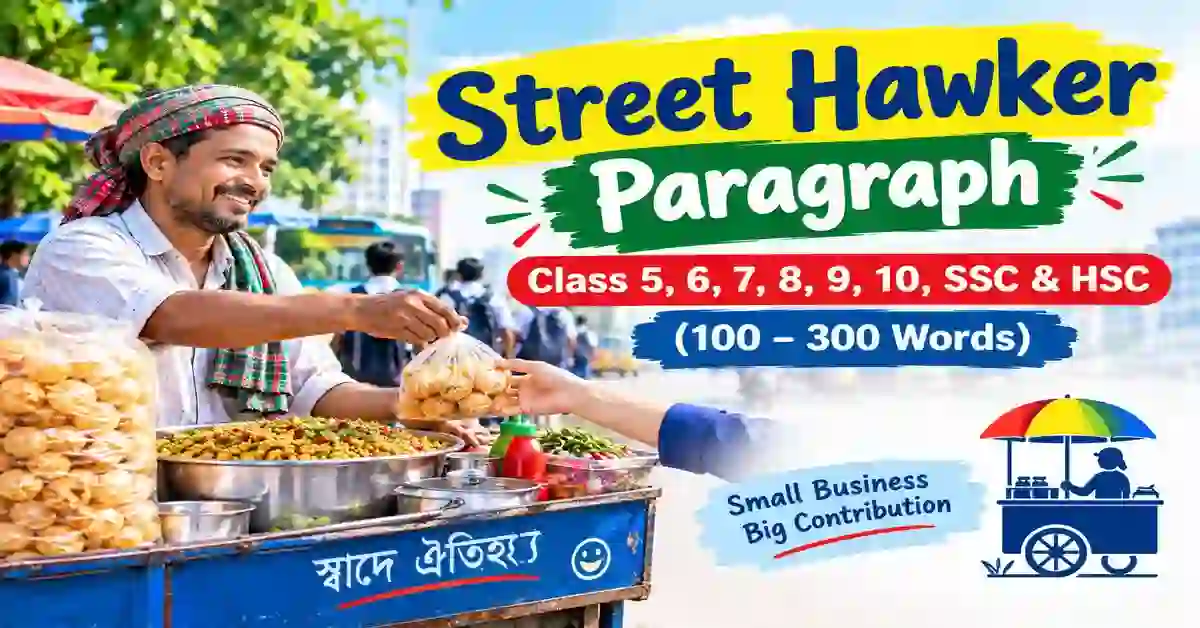
Developing strong paragraph writing skills is essential for students and exam candidates. In school tests and board exams, “A Street Hawker” is one of the most common and important descriptive topics. From Class 5 up to SSC and HSC levels, this paragraph frequently appears in English exams. To make learning easier and cater to different word limits (from 100 to 300 words), this article presents simple, well-structured street hawker paragraphs specifically designed for students of Class 5, 6, 7, 8, 9, 10, SSC, and HSC.
Read More: SSC English 2nd Paper Paragraph Suggestion 2027: 100% Common
Read More: Street Accident Paragraph for Class 5, 6, 7, 8, 9, 10, SSC and HSC (100–300 Words)
Street Hawker Paragraph (100 Words)
A street hawker is a familiar figure in cities, towns, and villages. He is a self-employed person who sells various daily items by moving from street to street. A hawker usually carries his goods on his head, in his hands, or on a small handcart. He sells toys, clothes, fruits, vegetables, household goods, and snacks. He attracts buyers, especially children and women, by calling out in a peculiar voice or ringing a bell. Although he works hard from morning till night in all weather conditions, his earnings are very low. A street hawker leads a struggle-filled life.
Read More: Sound Pollution Paragraph for Class 5, 6, 7, 8, 9, 10, SSC and HSC (100–300 Words)
Street Hawker Paragraph (150 Words)
A street hawker is a common sight in both urban and rural areas. He is a small trader who sells various goods by moving from one street to another. He usually carries his merchandise on his head, in big baskets, or on a small handcart. A street hawker sells a wide variety of items, including vegetables, fruits, utensils, toys, cosmetics, and cheap clothes. To attract customers, he shouts out the names of his products in a unique, musical tone or uses a bell. Children and housewives are his main customers because he delivers goods right to their doorsteps. Despite working tirelessly from early morning until late at night in sunshine and rain, his income is very modest. He often lives hand-to-mouth and cannot afford a comfortable life. Therefore, we should treat street hawkers with kindness and respect.
Read More: Environment Pollution Paragraph for Class 6 to HSC | পরিবেশ দূষণ অনুচ্ছেদ
Street Hawker Paragraph for Class 5 & 6
A street hawker is a person who sells things from street to street. He brings goods right to our house door. He carries toys, fruits, ice cream, sweets, and small household items on his head or a handcart. He calls out in funny and catchy sounds so that people know he has arrived. Children love to buy toys and treats from him. A street hawker works very hard all day under the hot sun and rain. But he does not earn much money. He lives a simple and tough life. We should always be polite to him.
Read More: A Winter Morning Paragraph 100, 150, 200, 250, 300 Words
Street Hawker Paragraph for Class 7 & 8
A street hawker is a familiar social figure in towns and villages alike. He earns his living by selling different types of daily necessaries from street to street. A hawker carries his items in baskets, on his shoulder, or on a small wooden cart. He deals in fruits, vegetables, toys, artificial jewelry, utensils, and ready-made garments. To call his customers, he utters peculiar cries or plays a whistle. Housewives and children are his frequent buyers since he offers low-priced items right at their doorsteps. Though a hawker renders great service to society, his life is full of hardship. He works hard from dawn to dusk to support his family.
Read More: A Rainy Day Paragraph For Six to HSC
Street Hawker Paragraph for Class 9 & SSC (250 Words)
A street hawker is an indispensable part of urban and rural life in developing countries. He is a small-scale, self-employed merchant who moves from street to street and door to door selling a wide range of everyday commodities. Without having a fixed shop or permanent place of business, he relies entirely on mobile trade to earn his daily bread. A hawker usually carries his merchandise in baskets on his head, in bags, or on a handcart. His inventory includes vegetables, fresh fruits, toys, ribbons, cosmetics, kitchen utensils, snacks, and cheap clothing items. To draw the attention of potential buyers, a street hawker adopts unique shouting styles, musical tunes, or uses bells and whistles. His chief buyers are housewives and young children, who find it convenient to purchase items right at their doorsteps without going to distant markets. The life of a street hawker is marked by endless toil and uncertainty. He starts his workday early in the morning and continues until late at night, braving scorching heat, heavy rain, and harsh winter conditions. Despite his relentless hard work, his profit margin remains meager, making it difficult to maintain a decent standard of living. Often, he faces harassment from local authorities and traffic restrictions on crowded roads. In conclusion, a street hawker plays a vital role in local commerce by offering convenience to households. He earns an honest living through physical labor, and society should view him with empathy and dignity.
Read More: Dowry System Paragraph for Class 6, 7, 8, 10, SSC & HSC (100, 150, 200 Words
Street Hawker Paragraph for HSC (300 Words)
A street hawker is a ubiquitous socio-economic figure in the everyday landscape of towns, cities, and villages. He is a mobile retailer who earns his livelihood by hawking various consumer goods from street to street and neighborhood to neighborhood. Lacking the financial capital to rent a permanent shop, he relies on his physical endurance, mobility, and persuasive skills to conduct small-scale business. The operational style of a street hawker is distinct and colorful. He transports his wares using baskets balanced on his head, shoulder poles, hand-drawn carts, or bicycles. His merchandise spans an array of inexpensive commodities, such as seasonal fruits, fresh vegetables, kitchenware, plastic products, children’s toys, cheap garments, and street snacks. To announce his arrival, he uses characteristic vocal calls, catchy rhymes, or acoustic devices like bells and horns. His primary clientele consists of home-makers, children, and low-income buyers who benefit from door-to-door delivery and negotiable prices. Despite rendering essential service to urban and rural households, a street hawker leads an extremely challenging existence. His survival depends on daily sales, leaving him vulnerable to economic fluctuations, sudden weather changes, and seasonal disruptions. He works long, exhausting hours under severe climatic conditions without any social security or job stability. Furthermore, street hawkers frequently endure evictions, extortion, and legal challenges due to unplanned urban street management. In conclusion, the street hawker represents the informal economy’s resilience and hard work. He provides convenient retail services to ordinary citizens while remaining an honest worker trying to support his family. Recognizing the economic contribution of street hawkers, municipal authorities should establish designated vending zones and protective policies to ensure their dignified survival within society.
Read More: Climate Change Paragraph for Class 6, 7, 8, 9, 10, SSC & HSC
Frequently Asked Questions (FAQ)
1. Who is a street hawker?
A street hawker is a self-employed mobile trader who sells various daily goods by moving from street to street without a permanent shop.
2. How does a street hawker carry his goods?
A street hawker carries his goods on his head, in baskets, on shoulder poles, on bicycles, or on small handcarts.
Read More: Price Hike paragraph
3. What items does a street hawker usually sell?
A street hawker sells fruits, vegetables, household utensils, toys, cosmetics, artificial jewelry, snacks, and low-cost clothes.
4. How does a street hawker attract customers?
He attracts customers by shouting out product names in peculiar tunes, singing catchy phrases, or ringing bells and blowing whistles.
5. Who are the main customers of a street hawker?
Housewives, children, and neighborhood residents are the primary customers of a street hawker.
6. Why is the Street Hawker Paragraph important for exams?
“A Street Hawker” is a popular descriptive paragraph topic frequently included in English exams for Class 5 to HSC students in Bangladesh.
Read More: 50 important Paragraph List
7. What is the ideal word limit for a Street Hawker Paragraph in Class 5 and 6?
For Class 5 and 6, a short paragraph of 80 to 100 words written in easy sentences is recommended.
8. What word count is expected for an SSC Street Hawker Paragraph?
For SSC candidates, a paragraph of 200 to 250 words covering the hawker’s lifestyle, items sold, daily struggles, and social role is ideal.
9. What should be included in an HSC Street Hawker Paragraph?
An HSC paragraph should be 250 to 300 words long, featuring elevated vocabulary, socio-economic analysis of informal trade, challenges faced, and policy suggestions.
10. How should we treat a street hawker?
We should treat a street hawker with respect, kindness, and fairness, acknowledging his hard work and honest living.
In conclusion, a street hawker is an essential figure in our daily lives who brings convenience to our doorsteps through hard physical work. Despite facing poverty, harsh weather, and economic instability, he earns an honest living and contributes significantly to the informal retail economy. As students and responsible citizens, studying his lifestyle teaches us empathy and respect for manual labor. Granting street hawkers fair treatment and legal vending spaces will ensure a more inclusive and compassionate society.
Read More:
১) ২০২৭ সালের এসএসসি ও সমমান পরীক্ষার জন্য সংশোধিত পুনর্বিন্যাসকৃত পাঠ্যসূচি
২) এসএসসি ২০২৭: নতুন সিলেবাস, প্রশ্নপত্রের কাঠামো এবং নম্বর বণ্টন




আসসালামু আলাইকুম ওয়া রাহমাতুল্লাহ। shikkhatech24.com ওয়েবসাইটে আপনাকে স্বাগতম। শিক্ষা, স্বাস্থ্য , প্রযুক্তি, টেক আপডেট, এসএসসি ও এইচএসসি সাজেশন, চাকরির খবর, উদ্যোক্তা, খাবার ব্যবস্থাপনা ইত্যাদি নানা বিষয় সম্পর্কে নিত্যনতুন তথ্য জানতে ওয়েবসাইটটি সাবস্ক্রাইব করুন এবং অন্যদের সাথে শেয়ার করুন।