
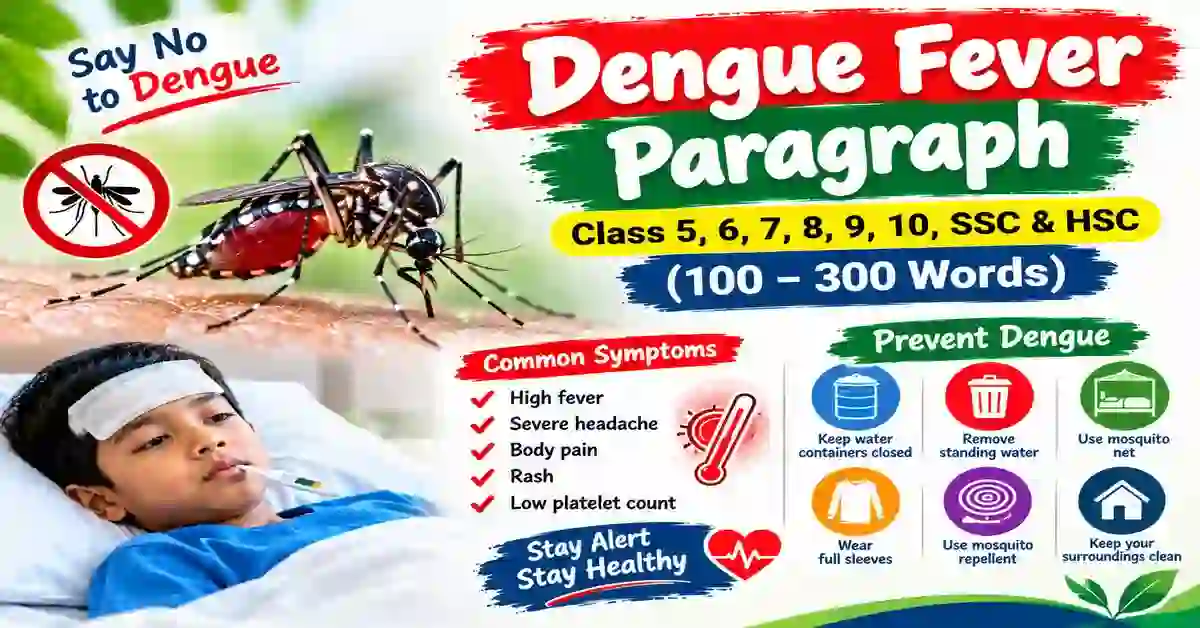
Dengue fever paragraph is a critical health and environmental topic in English writing for students across all academic levels in Bangladesh. In school examinations, model tests, and board exams, writing about dengue fever, its causes, symptoms, and preventive measures is a frequent task. From primary classes like Class 5 up to SSC and HSC, students are expected to articulate how this mosquito-borne viral disease impacts public health. To assist learners in preparing high-scoring answers, this comprehensive post presents tailored versions ranging from 100 to 300 words for Class 5, 6, 7, 8, 9, 10, SSC, and HSC.
Read More: Environment Pollution Paragraph for Class 6 to HSC | পরিবেশ দূষণ অনুচ্ছেদ
Dengue Fever Paragraph (100 Words)
Dengue fever is a mosquito-borne viral disease caused by the dengue virus. It is transmitted to humans through the bite of an infected female Aedes mosquito. Dengue mosquitoes breed primarily in clean, stagnant water found in flowerpots, discarded tires, and open containers. Common symptoms include high fever, severe headache, joint and muscle pain, and skin rashes. In severe cases, it leads to a drop in blood platelets. To prevent dengue fever, we must keep our surroundings clean, remove standing water, use mosquito nets while sleeping, and wear protective clothing to avoid mosquito bites.
Read More: A Winter Morning Paragraph 100, 150, 200, 250, 300 Words
Dengue Fever Paragraph (150 Words)
Dengue fever is a major viral infection that poses a serious threat to public health, especially during the rainy season. The disease spreads through the bite of female Aedes mosquitoes, which usually bite during early morning and late afternoon hours. The symptoms of dengue fever appear a few days after the bite and include sudden high fever, excruciating muscle and joint pain, pain behind the eyes, severe fatigue, nausea, and skin rashes. Severe dengue can cause severe bleeding and a critical drop in blood platelet counts, requiring immediate hospital care. Since there is no specific antiviral treatment for dengue, prevention is the best weapon. We should prevent water accumulation in flower tubs, buckets, roof corners, and coconut shells where Aedes mosquitoes lay eggs. Using mosquito repellents, sleeping under mosquito nets, and spreading public awareness can effectively control the outbreak of dengue fever.
Read More: A Rainy Day Paragraph For Six to HSC
Dengue Fever Paragraph for Class 5 & 6
Dengue fever is a dangerous sickness caused by mosquito bites. It is spread by the Aedes mosquito. These mosquitoes fly during the daytime and lay eggs in clean, stagnant water. When a person gets dengue fever, they suffer from high body temperature, bad headaches, body pain, and skin rashes. Drinking plenty of water and taking proper rest help patients recover. To stay safe from dengue, we must not let water collect in pots, cans, or tires around our homes. We should always sleep under a mosquito net and wear full-sleeve clothes.
Read More: Dowry System Paragraph for Class 6, 7, 8, 10, SSC & HSC (100, 150, 200 Words
Dengue Fever Paragraph for Class 7 & 8
Dengue fever is a widespread mosquito-borne viral infection in tropical and subtropical regions. It is transmitted by the bite of an infected Aedes mosquito, particularly Aedes aegypti. Unlike other mosquitoes, Aedes mosquitoes breed in clean, stagnant water collected in artificial containers around houses. A person suffering from dengue experiences sudden high fever, severe bone and joint pain, pain behind the eyes, vomiting, and extreme weakness. In serious cases, blood platelet levels drop drastically, leading to internal bleeding. Preventing dengue requires keeping our living areas clean, destroying mosquito breeding sites, using mosquito nets, and applying insect repellents daily.
Read More: Climate Change Paragraph for Class 6, 7, 8, 9, 10, SSC & HSC
Dengue Fever Paragraph for Class 9 & SSC (250 Words)
Dengue fever is a dangerous viral illness that has become a major public health concern in recent years, particularly in urban areas. It is caused by four distinct serotypes of the dengue virus and is transmitted to human beings through the bite of an infected female Aedes mosquito, primarily Aedes aegypti and Aedes albopictus. The symptoms of dengue fever typically manifest three to fourteen days after the infectious mosquito bite. The disease is characterized by sudden high fever, intense headaches, severe muscle and joint pain (often termed “breakbone fever”), pain behind the eyes, persistent nausea, and red skin rashes. In severe clinical conditions, known as Severe Dengue or Dengue Hemorrhagic Fever, patients may experience plasma leakage, internal bleeding, a dangerous drop in blood platelet levels, and sudden shock, which can be fatal without timely medical intervention. Controlling dengue fever relies heavily on preventive measures, as there is no specific antiviral cure available. Vector control is the most effective approach to curb the disease. Citizens must ensure that clear water does not stagnate in flower tubs, roof drains, water tanks, discarded containers, or plastic bottles for more than three days. Additionally, applying mosquito repellents, wearing full-sleeve clothing, using mosquito coils, and sleeping under protective nets both day and night are crucial safety precautions. City corporations and civic authorities must conduct regular fogging, larvicidal spraying, and public awareness campaigns to eliminate mosquito breeding grounds and protect community health.
Read More: Price Hike paragraph
Dengue Fever Paragraph for HSC (300 Words)
Dengue fever is a formidable mosquito-borne arboviral disease that represents a critical public health challenge in tropical and subtropical nations, including Bangladesh. Caused by four closely related viral serotypes (DEN-1, DEN-2, DEN-3, DEN-4), the virus relies on vector transmission via female Aedes mosquitoes. The ongoing rapid urbanization, high population density, inadequate waste management systems, and climate change-induced prolonged monsoons have created optimal environmental conditions for vector proliferation. The clinical spectrum of dengue infection ranges from mild febrile illness to severe life-threatening complications. Classic symptoms include acute high-grade fever, severe retro-orbital pain, debilitating arthralgia and myalgia, persistent vomiting, severe physical prostration, and characteristic maculopapular rashes. A major pathophysiological hazard occurs when the virus causes plasma leakage and a precipitous decline in circulating blood platelets (thrombocytopenia). This progression can result in Dengue Hemorrhagic Fever (DHF) or Dengue Shock Syndrome (DSS), requiring urgent hospitalization, close monitoring, and fluid management. Addressing the dengue crisis demands an integrated vector management strategy combined with active civic participation. Because Aedes mosquitoes breed predominantly in clean, stagnant water within domestic and peri-domestic environments, source reduction—such as eliminating water accumulation in artificial containers, tires, construction sites, and plant saucers—is paramount. Municipal bodies must execute systematic larvicidal spraying, clear clogged urban drainage channels, and maintain transparent epidemiological surveillance. Simultaneously, individuals must adopt personal protective measures, including the application of mosquito repellents, installation of window screens, and consistent use of bed nets. Dengue fever is not merely an individual health issue but a complex environmental and societal challenge. Mitigating its impact requires synchronized efforts between municipal authorities, healthcare infrastructures, and informed citizens to foster clean, mosquito-free communities and safeguard public life.
Read More: 50 important Paragraph List
Frequently Asked Questions
1. What causes dengue fever?
Dengue fever is caused by the dengue virus, which is transmitted to humans through the bite of an infected female Aedes mosquito.
2. Where do Aedes mosquitoes usually breed?
Aedes mosquitoes breed in clean, stagnant water collected in artificial containers, flowerpots, discarded tires, buckets, open tanks, and roof corners.
3. What time of day do Aedes mosquitoes usually bite?
Aedes mosquitoes are most active during the daytime, particularly during early morning hours and late afternoon before dusk.
4. What are the primary symptoms of dengue fever?
Symptoms include sudden high fever, severe headache, muscle and joint pain, pain behind the eyes, extreme fatigue, nausea, and skin rashes.
5. What is the dangerous complication associated with severe dengue?
Severe dengue can cause a drastic drop in blood platelet counts (thrombocytopenia), internal bleeding, plasma leakage, and Dengue Shock Syndrome (DSS).
6. Why is dengue fever called “breakbone fever”?
It is often called “breakbone fever” because of the severe, excruciating muscle and bone pain experienced by patients during the infection.
7. How long is the incubation period for dengue fever?
The incubation period typically ranges from 3 to 14 days after being bitten by an infected mosquito, though symptoms usually appear within 4 to 7 days.
8. What is the recommended word limit for a Dengue Fever Paragraph in Class 5 and 6?
For Class 5 and 6 students, a concise paragraph between 80 to 100 words written in simple, clear sentences is recommended.
9. How long should a Dengue Fever Paragraph be for SSC candidates?
SSC candidates should write a detailed paragraph of 200 to 250 words covering vector transmission, clinical symptoms, severe complications, and prevention methods.
10. How can we prevent dengue fever in our households?
We can prevent dengue by removing standing water every three days, using mosquito repellents, sleeping under mosquito nets, wearing protective clothing, and keeping our surroundings clean.
Read More: SSC English 2nd Paper Paragraph Suggestion 2027: 100% Common
Dengue fever paragraph concludes by emphasizing that community hygiene and preventive action are key to stopping dengue outbreaks. While dengue can turn severe without medical care, destroying mosquito breeding grounds in and around our homes dramatically reduces infection risks. Through collective social awareness, timely medical intervention, and efficient municipal sanitation practices, we can effectively manage the menace of dengue fever and protect public health.
Read More:
১) ২০২৭ সালের এসএসসি ও সমমান পরীক্ষার জন্য সংশোধিত পুনর্বিন্যাসকৃত পাঠ্যসূচি
২) এসএসসি ২০২৭: নতুন সিলেবাস, প্রশ্নপত্রের কাঠামো এবং নম্বর বণ্টন




আসসালামু আলাইকুম ওয়া রাহমাতুল্লাহ। shikkhatech24.com ওয়েবসাইটে আপনাকে স্বাগতম। শিক্ষা, স্বাস্থ্য , প্রযুক্তি, টেক আপডেট, এসএসসি ও এইচএসসি সাজেশন, চাকরির খবর, উদ্যোক্তা, খাবার ব্যবস্থাপনা ইত্যাদি নানা বিষয় সম্পর্কে নিত্যনতুন তথ্য জানতে ওয়েবসাইটটি সাবস্ক্রাইব করুন এবং অন্যদের সাথে শেয়ার করুন।