
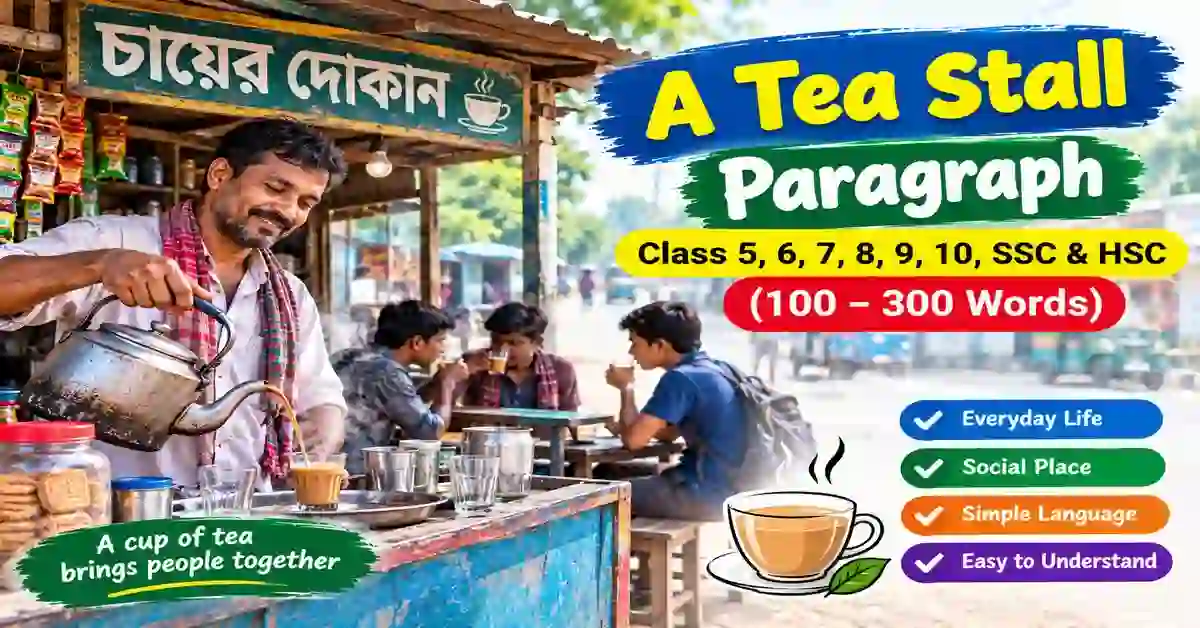
A tea stall paragraph is a fundamental topic in English writing for students across all academic levels in Bangladesh. In school examinations, test papers, and board exams, writing about a local tea stall is a popular descriptive task. From primary classes like Class 5 up to SSC and HSC, students are often asked to describe the appearance, social atmosphere, and daily life around a tea stall. To assist learners in preparing high-scoring answers, this comprehensive post presents tailored versions ranging from 100 to 300 words for Class 5, 6, 7, 8, 9, 10, SSC, and HSC.
Read More: SSC English 2nd Paper Paragraph Suggestion 2027: 100% Common
A Tea Stall Paragraph (100 Words)
A tea stall paragraph describes a very common and familiar place in our country. A tea stall is a small shop where hot tea and light snacks are sold. It is usually found at road crossings, bus stands, railway stations, market areas, and near educational institutions. A tea stall is usually furnished with a few simple wooden benches and chairs. The stall owner or a young boy prepares and serves tea to customers. Along with tea, items like biscuits, bananas, bread, and betel leaves are sold here. People of all ages gather at a tea stall to refresh themselves and chat.
Read More: Sound Pollution Paragraph for Class 5, 6, 7, 8, 9, 10, SSC and HSC (100–300 Words)
A Tea Stall Paragraph (150 Words)
A tea stall paragraph highlights a prominent meeting place in both rural and urban Bangladesh. A tea stall is a small, modest shop where freshly brewed tea, snacks, and daily items are served to visitors. It is typically situated at busy locations such as street corners, railway stations, village bazaars, and office areas. The interior of a tea stall is quite simple, containing wooden benches, tables, and a counter with a stove. The stall owner or a boy serves hot tea in small cups. Besides tea, snacks like biscuits, buns, cakes, cigarettes, and betel leaves are readily available. People from various walks of life labourers, students, office workers, and rickshaw pullers visit a tea stall to take a break from work. While sipping hot tea, they talk about politics, sports, and social issues, making a tea stall a lively mini-assembly.
Read More: Environment Pollution Paragraph for Class 6 to HSC | পরিবেশ দূষণ অনুচ্ছেদ
A Tea Stall Paragraph for Class 5 & 6
A tea stall paragraph introduces us to a small shop that we see everywhere. A tea stall sells hot tea, biscuits, bread, and bananas. It is found near roads, markets, and school gates. Inside a tea stall, there are simple benches for people to sit. A boy or the shopkeeper brews tea on a stove and serves it in small cups. People come here when they feel tired. They drink hot tea, talk with friends, and feel refreshed. Children also like to buy biscuits from a tea stall. It is a very useful and friendly small shop.
Read More: A Winter Morning Paragraph 100, 150, 200, 250, 300 Words
A Tea Stall Paragraph for Class 7 & 8
A tea stall paragraph reflects a small yet important social hub in our daily life. A tea stall is a small retail shop where hot tea, snacks, and minor commodities are sold. It is generally found in crowded spots such as market places, bus terminals, launch ghats, and street corners. The setup of a tea stall is humble, usually featuring a few wooden tables, benches, and a kettle boiling on a gas stove. People visit tea stalls to refresh themselves after hard work. While enjoying a cup of tea, customers discuss local news, politics, and family matters. A tea stall remains busy from early morning until late night.
Read More: A Rainy Day Paragraph For Six to HSC
A Tea Stall Paragraph for Class 9 & SSC (250 Words)
A tea stall paragraph captures an integral social element of Bangladeshi culture. A tea stall is a small, ubiquitous shop where hot tea and light refreshments are sold to passersby and locals. These stalls are found in almost every neighborhood, village bazaar, bus stand, railway station, and street corner across the country. The setup of a typical tea stall is simple and unpretentious. It is usually housed in a tin-shed or wooden structure equipped with a few rough wooden benches, tables, and a tea-making counter. A kettle of water boils continuously on a stove. The stall keeper or a young assistant mixes tea leaves, milk, and sugar to brew fresh tea for incoming customers. In addition to milk tea and raw tea, the stall offers biscuits, bread, bananas, cakes, betel leaf (paan), and cigarettes. Beyond being a commercial outlet, a tea stall acts as a popular mini-social hub. People from diverse social and economic backgrounds including farmers, rickshaw pullers, students, service holders, and senior citizens gather here throughout the day. Drinking hot tea provides relief from daily exhaustion and physical fatigue. While sipping their cups, customers engage in passionate discussions on various topics, ranging from village affairs and national politics to international sports events. However, many tea stalls maintain poor hygienic conditions, as cups are often washed in standing water, and trash accumulates nearby. Despite these shortcomings, a tea stall remains a vital, lively center of social interaction in everyday life.
Read More: Dowry System Paragraph for Class 6, 7, 8, 10, SSC & HSC
A Tea Stall Paragraph for HSC (300 Words)
A tea stall paragraph presents a vivid picture of one of the most culturally iconic informal institutions in Bangladesh. A tea stall is a small, informal retail kiosk that specializes in serving hot tea, light food items, and tobacco products. Located strategically at bustling street intersections, transportation hubs, corporate plazas, and rural marketplaces, the tea stall operates as a ubiquitous landmark in both urban centers and agrarian landscapes. Architecturally, a tea stall is humble, constructed from bamboo, corrugated tin, or timber, though urban variants sometimes occupy small brick rooms. The core fixture is the tea counter, featuring a constantly simmering kettle, glass jars containing dry snacks, and a radio or television set playing local news or music. Seating is rudimentary, comprising long wooden benches or plastic stools. The tea maker, often assisted by a young boy known affectionately as a “chhotomaam,” skillfully pulls milk tea between vessels to create a rich, frothy beverage. The socio-cultural significance of a tea stall extends far beyond its function as a refreshment point. It operates as an informal public sphere where socio-economic boundaries blur. Individuals across all demographic strata converge to rest, socialize, and debate. A tea stall is famously referred to as a “mini-parliament,” as patrons engage in spontaneous and spirited discourse covering domestic politics, global economic affairs, cricket matches, and community grievances. For working-class laborers and rickshaw pullers, it offers an affordable respite from strenuous manual work. Despite its cultural charm, the tea stall ecosystem faces challenges regarding sanitation, waste disposal, and child labor. Cleanliness is frequently neglected, with unhygienic water used for washing utensils. In conclusion, a tea stall paragraph illustrates not merely a business enterprise, but a living vibrant social forum that reflects the pulse, camaraderie, and democratic spirit of public life in Bangladesh.
Read More: Climate Change Paragraph for Class 6, 7, 8, 9, 10, SSC & HSC
Frequently Asked Questions
1. What is a tea stall?
A tea stall is a small informal shop where hot tea, light snacks, and everyday items like biscuits and betel leaves are sold to customers.
2. Where are tea stalls usually situated?
Tea stalls are usually located at street crossings, village bazaars, bus stands, railway stations, launch ghats, and near educational or office areas.
Read More: Price Hike paragraph
3. Why is a tea stall called a “mini-parliament”?
It is called a “mini-parliament” because people gather there to discuss and debate various political, social, sports, and local issues while sipping tea.
4. What food items are sold in a tea stall?
Apart from milk tea and raw tea, items such as biscuits, buns, bananas, cakes, betel leaves, and cigarettes are commonly sold in a tea stall.
5. Who are the frequent visitors to a tea stall?
People of all occupations including rickshaw pullers, day laborers, students, office workers, and local elders frequently visit tea stalls.
6. Why is a tea stall paragraph important for exams?
A tea stall paragraph is a classic descriptive writing topic frequently set in English language exams from Class 5 up to SSC and HSC levels in Bangladesh.
Read More: 50 important Paragraph List
7. What is the standard word count for a tea stall paragraph in Class 5 and 6?
For Class 5 and 6 students, a short paragraph of 80 to 100 words in clear, simple language is recommended.
8. How long should a tea stall paragraph be for SSC candidates?
SSC candidates should write a detailed paragraph of 200 to 250 words explaining the physical setup, items sold, social environment, and hygiene factors.
9. What word count is expected for an HSC tea stall paragraph?
For HSC candidates, a sophisticated paragraph of 250 to 300 words analyzing the socio-cultural role, informal economy impact, and public sphere dynamics is expected.
10. What are the common drawbacks of a typical tea stall?
Common drawbacks include poor hygiene, unwashed utensils, lack of proper waste management, overcrowding, and the prevalence of child labor.
A tea stall paragraph concludes by highlighting how a simple tea shop reflects the heart of community bonding and daily life in our society. More than just a commercial spot for a quick beverage, a tea stall serves as a democratic meeting place where people connect, unwind, and exchange ideas freely. Addressing hygiene standards and working conditions in these stalls can enhance their value even further. Ultimately, the tea stall remains an enduring symbol of togetherness, warmth, and informal culture across Bangladesh.
Read More:
১) ২০২৭ সালের এসএসসি ও সমমান পরীক্ষার জন্য সংশোধিত পুনর্বিন্যাসকৃত পাঠ্যসূচি
২) এসএসসি ২০২৭: নতুন সিলেবাস, প্রশ্নপত্রের কাঠামো এবং নম্বর বণ্টন


আসসালামু আলাইকুম ওয়া রাহমাতুল্লাহ। shikkhatech24.com ওয়েবসাইটে আপনাকে স্বাগতম। শিক্ষা, স্বাস্থ্য , প্রযুক্তি, টেক আপডেট, এসএসসি ও এইচএসসি সাজেশন, চাকরির খবর, উদ্যোক্তা, খাবার ব্যবস্থাপনা ইত্যাদি নানা বিষয় সম্পর্কে নিত্যনতুন তথ্য জানতে ওয়েবসাইটটি সাবস্ক্রাইব করুন এবং অন্যদের সাথে শেয়ার করুন।